
Mississauga
Reviewed by Thusheinth Sivarajah, MScPT, Registered Physiotherapist · Last reviewed November 2026
Breaking a bone affects more than the bone itself. Time in a cast, sling or boot leaves nearby joints stiff, muscles weak and confidence shaken. Physiotherapy helps you get moving again safely as the bone heals.
Physiotherapists at our Port Credit and Trinity Bellwoods clinics guide you through every phase of recovery after a fracture, fracture surgery or joint replacement, working with your surgeon's or doctor's instructions. This page links to our detailed guides for each type. No referral needed.
5.0 · 640+ Google reviewsNo referral needed
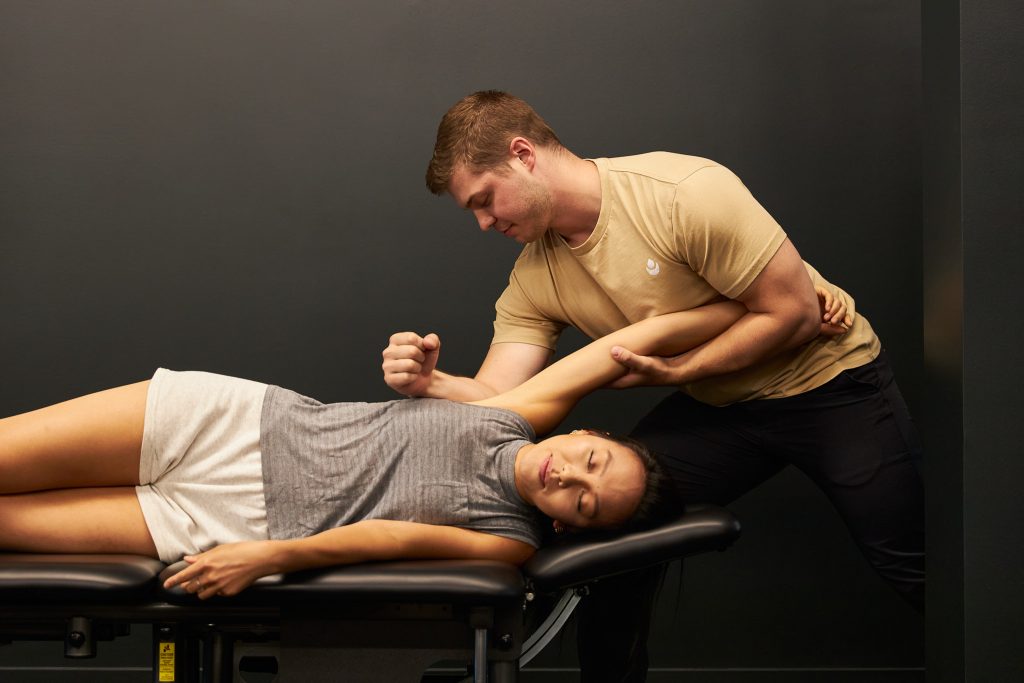
Each type of fracture has its own healing timeline and rehab focus. Explore our detailed pages:
Some fractures, or severe arthritis, are treated with joint replacement surgery:
We also see people for fractures of the collarbone, ribs, fingers, foot and lower leg. If your injury isn't listed, ask us.
No matter which bone was involved, the goals are similar: protect healing, restore movement, rebuild strength and get you back to daily life, work and the activities you enjoy. Each page above explains typical timelines, what rehab involves and common precautions for that injury. Your own surgeon's or doctor's instructions always come first, and your physiotherapist will follow them closely while keeping you as active as is safe.
Bone healing follows a fairly predictable pattern. First, a blood clot forms around the break. Over the next few weeks, soft new bone (callus) bridges the gap. That callus then hardens and slowly remodels to become strong again, a process that can take months.
Many fractures are stable enough for more normal use around six to eight weeks, but this varies a lot. Things that affect healing include:
Your surgeon or doctor decides when the bone can take weight or load. Your physiotherapist works within those limits and helps you make the most of each stage. Eating enough protein and calcium also supports healing. Our nutrition coaching team can help if you're unsure where to start.
Most fracture rehab moves through four broad phases. Your exact timing will depend on your injury and medical team.
Each phase builds on the one before. Moving too fast can stress healing bone, while waiting too long can leave lasting stiffness. Your physiotherapist will help you find the right balance and progress as healing allows.
Free 20-minute consultation
Not sure where to start? Talk to our team for free.
Tell us what is going on and we will match you with the right practitioner. No obligation.
Please bring any information you have from the hospital or fracture clinic: discharge papers, surgical notes, X-ray reports and weight-bearing instructions. These help us follow your medical team's plan.
Your physiotherapist will assess:
You will leave with a home program for your current phase, tips for managing pain and swelling, and a plan for how often to come in.
Fractures often happen suddenly and can be frightening. We take time to answer questions and explain what to expect so you feel more in control of your recovery. Our surgical rehab page has more on recovery after orthopaedic surgery.
If you broke a bone from a minor fall, such as tripping from standing height, it may be a sign of low bone density. These are called fragility fractures, and they are often the first sign of osteoporosis. Wrist, hip, spine and upper arm fractures are the most common.
After a fragility fracture, it is worth asking your doctor about a bone density test. Physiotherapy can then help lower your risk of future fractures through:
See our pages on osteoporosis physiotherapy and falls prevention to learn more.
Athletes with stress fractures may also need to look at training load, footwear and nutrition, since low energy intake can affect bone health. Our team can help with running assessments and custom orthotics when they're appropriate.
Contact your doctor or go to the emergency department right away if you notice:
Call 911 for chest pain or sudden shortness of breath, which can be signs of a blood clot in the lungs.
When you're ready, book physiotherapy at our Mississauga or Toronto clinic. No referral is needed, though some insurance plans require one for claims. We direct bill most extended health plans. Have questions about where to start? Book a free 20-minute consultation, in person or virtual.
Many people start while still in a cast or boot to keep nearby joints moving. Your physio will follow your doctor's instructions on what's safe.
Yes, stiffness and weakness are very common after immobilization. Regular exercise usually helps movement return over the following weeks.
It depends on your doctor's weight-bearing instructions. Your physio will teach you how to walk safely within those limits.
Yes. We see people after surgery with plates, screws, rods and joint replacement. Learn more on our surgical rehab page.
It varies widely, from a few weeks for a simple break to several months after surgery. Your physiotherapist will give you a realistic estimate after your assessment.
Questions about your symptoms? Talk to our team in Mississauga or Toronto.
For more background, these organizations offer reliable, plain-language information. It is general information and does not replace advice from your own clinician.
Find your nearest location.